Most birdwatching guides describe habitats in general terms — wetland, scrub, forest, farmland. But the connection between specific plant communities and specific bird species is much more precise than these categories suggest. In the Mediterranean, where plant communities respond sharply to soil type, altitude, moisture and land-use history, learning to read the vegetation is one of the most reliable ways to predict what birds you will find before you've raised your binoculars.
This guide covers the main plant communities of eastern Spain and the birds most closely associated with each.
Garriga and low Mediterranean scrub
Garriga — the low, often thorny scrub of the Mediterranean lowlands — is dominated by Rosemary (Rosmarinus officinalis), Kermes Oak (Quercus coccifera), Rockrose (Cistus spp.) and various Lavender species. It grows on thin, dry, limestone soils and is often the result of long-term overgrazing or fire in formerly forested land.
This is the primary habitat of Sardinian Warbler — loud, dark-capped and almost always present in any patch of garriga in Valencia. Dartford Warbler is patchier but associated with the same dense, low scrub. Thekla Lark prefers the open, rocky areas within garriga, while Black-eared Wheatear uses the stones and bare soil.
Holm oak woodland (encinar)
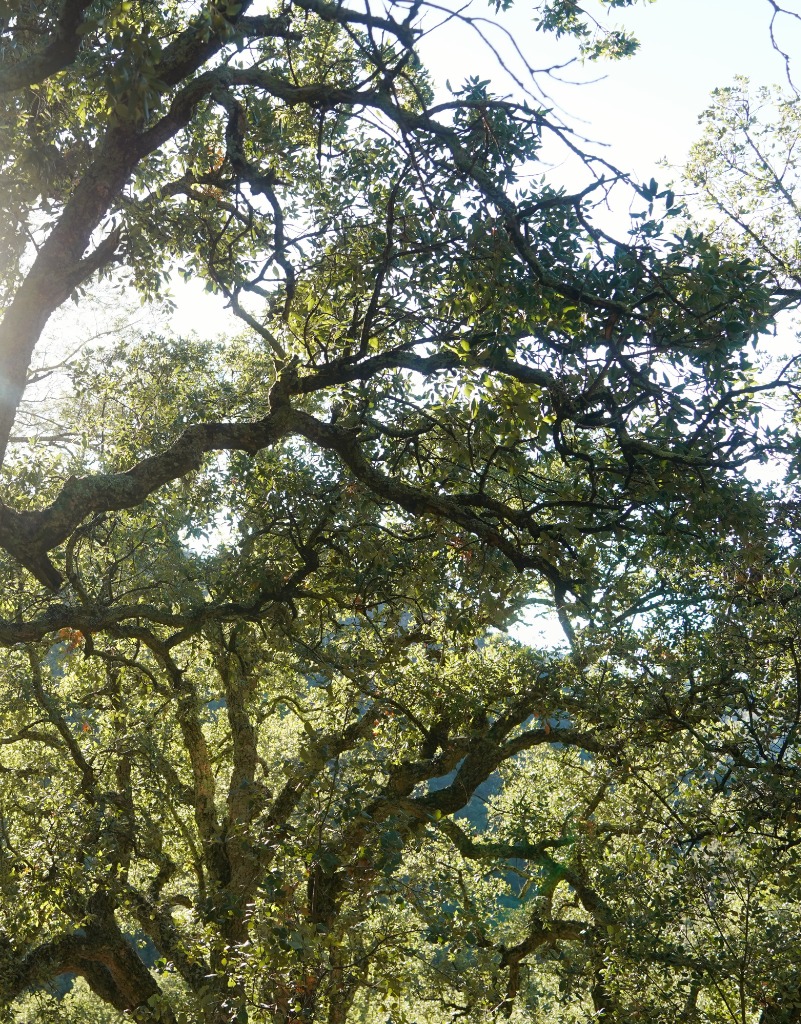
The Holm Oak (Quercus ilex) is the climax tree of the Mediterranean lowlands. Where it grows in mature stands — and these are increasingly rare — it creates a dense, dark canopy that supports a distinct bird community. The acorn crop in autumn draws in large numbers of Jay, Nuthatch, Short-toed Treecreeper and Hawfinch.
The open ground beneath old holm oaks is the preferred hunting habitat of Short-toed Eagle and Booted Eagle. Tawny Owl nests in tree cavities, and where the woodland edges are open, Hoopoe and Wryneck feed on the ground. A well-structured holm oak wood is one of the richest birding habitats in the Inland Valencia.
Riverine woodland
Along seasonal rivers and irrigation channels, a narrow band of deciduous and semi-deciduous trees persists: White Poplar, Tamarisk, White Willow and Oleander. This riparian strip, often only 20–30 metres wide, concentrates moisture and food in an otherwise dry landscape and acts as a migration corridor.
It is the best habitat for Common Nightingale in spring and summer — dense tamarisk thickets are almost guaranteed to hold singing birds from April. Cetti's Warbler is present year-round in any wet vegetation near water. Golden Oriole nests in the poplars, Penduline Tit in the willows, and Kingfisher along the water channel itself.
Reedbeds
Where water is permanent, Common Reed (Phragmites australis) forms dense stands that are structurally simple but biologically rich. The reed provides nesting structure for several specialist warblers — Great Reed Warbler, Eurasian Reed Warbler, Moustached Warbler and Cetti's Warbler — and cover for Purple Heron, Little Bittern and Water Rail.
The boundary between reedbed and open water is the most productive zone: this is where Purple Swamphen feeds, where herons stand at the water's edge, and where Marsh Harrier quarters low over the reed tops.
Dry steppe and cereal land
The high plateau of the Inland Valencia — the Meseta Valencia and the plains around Requena — supports a different flora: Esparto Grass (Stipa tenacissima), Feather Grass (Stipa pennata), Dwarf Fan Palm (Chamaerops humilis) in the south, and sparse cereal cultivation. These open, semi-arid landscapes hold the most threatened bird community in the region.
Calandra Lark is the characteristic bird of intact steppe — its rich, varied song is one of the distinctive sounds of a warm spring morning in the interior. Little Bustard displays on open ground in April and May. Stone Curlew breeds wherever the ground is bare enough. Where cereal cultivation persists at low intensity, Montagu's Harrier nests on the ground among the crops.
Using plants to read the landscape
The practical application is straightforward. When you arrive at a new site, look at the vegetation before you look for birds. Dense Rosemary on limestone — expect Sardinian Warbler and Dartford Warbler. Mature Holm Oak — Tawny Owl, Nuthatch, Short-toed Eagle nearby. Tamarisk along a dry riverbed — Nightingale, Cetti's Warbler, Kingfisher if there's water. Phragmites on standing water — Marsh Harrier, Purple Heron, Great Reed Warbler.
The plant community tells you the soil, the moisture and the land history. The bird community follows from those conditions. They are not separate things.
Our botany routes are designed around exactly this approach — learning to read the landscape through its plants as a way of understanding the birds. Available as half-day or full-day itineraries in the Valencia region.
Book a botany and birding day